
Injury Prevention
WHY ARE SO MANY TEEN GIRLS STILL TEARING THEIR ACLs?
A recent New York Times Magazine feature explores the growing concern around ACL injuries in girls’ and women’s sports—an issue affecting athletes at every level, from youth leagues to the professional stage. The article highlights how female athletes are significantly more likely to suffer these serious knee injuries, driven by a complex mix of biological, biomechanical, and environmental factors.Beyond the statistics, the story dives into the real-life impact of ACL tears—long recoveries, lost playing time, and the emotional toll on young athletes. It also emphasizes that many of these injuries can be reduced and/or prevented through proper training techniques, strength development, and movement awareness when the right programs are in place.For parents, coaches, and athletes, this article offers valuable insight into why these injuries are happening—and what can be done to reduce the risk. Read the full piece and supplemental information on this page below to better understand the challenges and explore how smarter training and prevention can help keep athletes healthy and in the game.
Downloadable Link
Techniques and Trainings
FIFA Injury Page
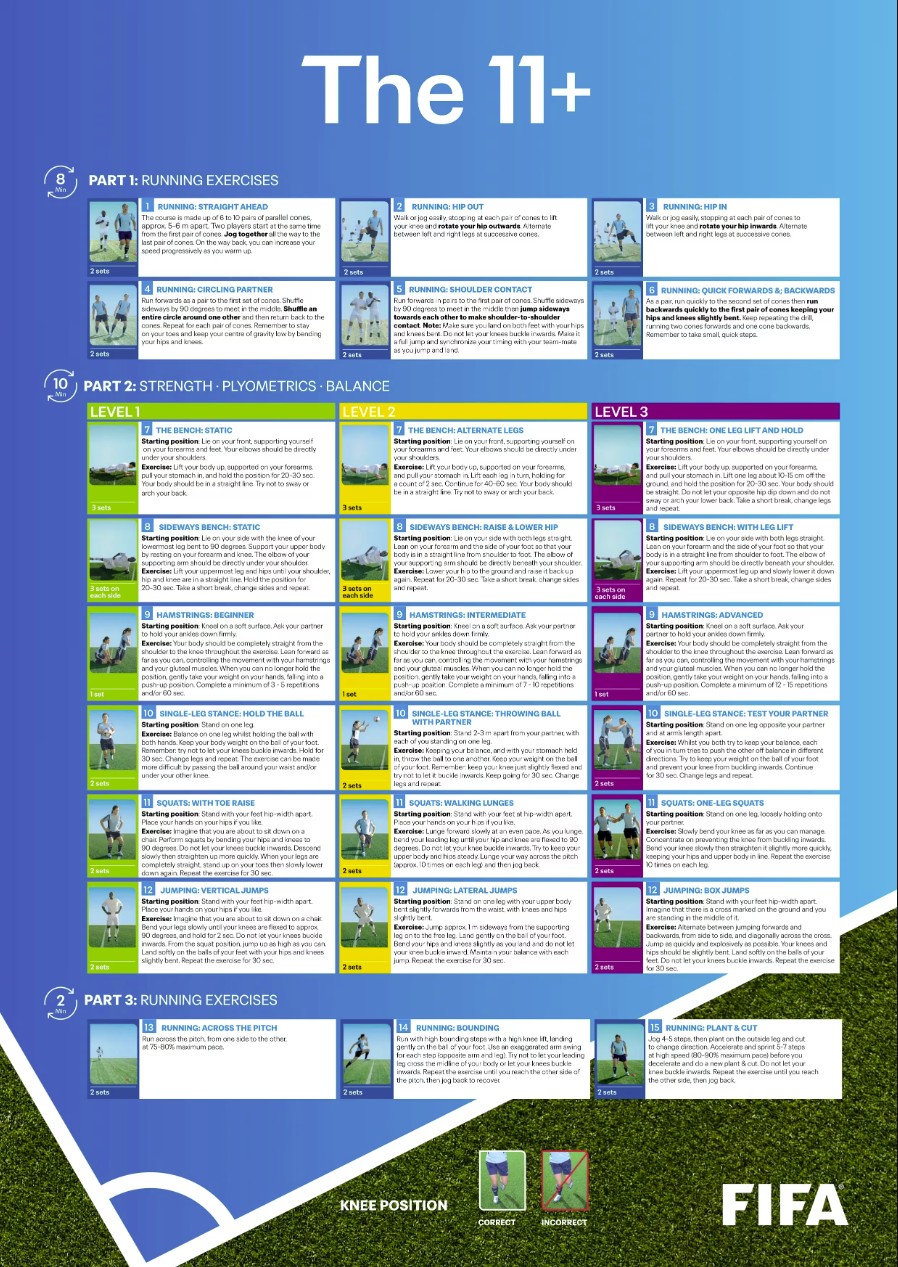
FIFA 11+
FIFA GoalKeeper Warmup Program
PART 1: CARDIOPULMONARY
Aims of part 1:
- to increase the heart rate, body temperature, respiratory rate and blood flow; - to get into the groove for the rest of the warm-up.
1. One-handed ball bounces on the move (movie)
Exercise: start in a standing position on the goal line, with the ball held at pelvis height. Jog to the cone and back while performing one-handed ball bounces.
Key points:
∙ Ball to be stopped at shoulder height
∙ Focus is on gripping technique when bouncing ball
∙ Fingers to be spread as widely as possible when bouncing ball
Repetitions: Two (one clockwise, one anticlockwise).
2. One- and two-handed ball lifts on the move (movie)
Exercise: start in a standing position on the goal line, with the ball held at pelvis height. Jog to the cone and back while lifting the ball with both hands. Next, repeat but with one-handed ball lifts; after each ball lift, lift with the other side.
Key points:
∙ Ball to be elevated as high as possible
∙ Elbows to be kept straight
∙ Eyes to be kept on ball throughout
Repetitions: Two (one of each type).
3. Arm swings with the ball on the move followed by sidesteps with double-handed bounces (movie)
Exercise: start in a standing position on the goal line, with the ball held at pelvis height. Jog to the cone while swinging your arms from side to side. On the way back, perform sidesteps with double-handed bounces.
Key points:
∙ Torso rotation to be kept to minimum while arms are being swung
∙ Eyes to be kept on ball throughout
∙ Ball to be stopped at shoulder height when bouncing it
Repetitions: Two (one clockwise, one anticlockwise).
4. Alternating hops while transferring the ball under the leg, followed by jogging backwards (movie)
Exercise: start in a standing position on the goal line, with the ball held at pelvis height. Hop to the cone while transferring the ball under alternating legs. On the way back, jog backwards to the goal line.
Key points:
∙ Back to be kept straight when front knee is elevated
∙ Front knee to be brought towards chest
∙ Shoulder, hip, knee and foot of supporting leg should be aligned
Repetitions: Two (one clockwise, one anticlockwise).
5. Jumps and ball catches (movie)
Exercise: start in a standing position on the goal line, with the ball held at pelvis height. Throw the ball in the air, jump and catch it repeatedly en route to the cone. Jog back to the goal.
Key points:
∙ Ball to be caught at highest possible point
∙ One “protection leg” to be kept in front of body
∙ Hip, knee and toes of landing leg should be aligned
∙ Eyes to be kept on ball while jumping
Repetitions: Two (one clockwise, one anticlockwise).
6. Roll the ball and gather (movie)
Exercise: start in a standing position on the goal line, with the ball held at pelvis height. Roll the ball to the right, follow it and pick it up. Return to the goal line, jogging backwards, and roll the ball in another direction.
Key points:
∙ Focus is on gripping technique
∙ Hips to be kept below shoulders when bending forwards to gather ball
Repetitions: Three of the full sequence.
PART 2: PROGRESSIVE MOBILITY, ACTIVATION AND STABILITY EXERCISES
Aims of part 2:
- activation of the core, as core stability is important in injury prevention;
- activation of the central nervous system;
- mobilisation of key joints and ranges of motion used in goalkeepers’ activities.
1. Raised plank with arm lift (movie)
Exercise: start in a standing position with a straight back pressed against the goalpost and both hands holding the goalpost. Slowly bend forwards and lower your hands along the goalpost between your legs, and then put your hands on the ground and lean forwards until reaching a push-up position. From the stable push-up position, activate your core muscles and extend one arm forwards, to the side and up with rotation. Hold each position for two seconds. In between each position, briefly put the hand back on the ground. Repeat with the other arm. Slowly move back to the starting position.
Key points:
∙ In first phase of exercise, buttocks to be kept in contact with post
∙ Trunk and legs to be kept straight throughout exercise
∙ In plank position, body should stay aligned from head to toes and elbows should be kept under shoulders
∙ During trunk rotation, hands to be kept straight
Repetitions: Five.
2. One-leg lateral squat (movie)
Exercise: start in a wide stance, facing the goalpost with a straight back and both hands on the goalpost. Flex your left knee, while keeping your right leg straight and almost touching the ground and extending your left arm to the side. Push through your left foot to return to the starting position. Repeat on the other side.
Key points:
∙ Shoulder, hip, knee and feet of loaded side to be kept aligned
∙ Limb extension
∙ External hip rotation
∙ Feet to be kept parallel while returning to starting position
Repetitions: Five per side.
3. Backward lunge (movie)
Exercise: start in a narrow stance, facing and holding the goalpost. Move your right leg back by keeping it extended and extend your left leg. Flex your front leg and push back to the starting position. Repeat with the other leg.
Key points:
∙ Both knees to be kept extended as far as possible
∙ Torso to be kept in a straight line
∙ Arms to be kept straight
Repetitions: Five per leg.
4. Diagonal backward lunge (movie)
Exercise: start in an athletic stance, facing and holding the goalpost. Extend your left arm laterally and move your right leg diagonally backwards, while flexing your left leg. Hold this position for a few seconds. Push down into the ground explosively with your right leg and return to the starting position. Repeat on the other side.
Key points:
∙ Front knee and foot to be kept in a straight line
∙ Knee to be extended as fully as possible
∙ Torso to be kept straight
Repetitions: Five per side.
5. Sumo squat (movie)
Exercise: start in a wide stance with your legs extended and then reach down to touch your toes. Try to keep your back straight. From this position, go into a sumo squat and hold the position for three seconds, pushing your chest out. Activate your core muscles and raise your right and left arm. Stand up and return to the starting position.
Key points:
∙ Torso and knees to be kept extended during first phase of exercise
∙ Head to be kept aligned with torso
∙ Knees and feet to be kept aligned
∙ Knees to be pushed outwards
Repetitions: 5
6. Lunges with the ball held in front of the body (movie)
Exercise: start in an athletic stance, holding the ball between your hands. With your right leg, lunge forwards, backwards, laterally to the right, diagonally to the right and laterally to the left. Hold each lunge position for a second. In between each lunge, return to the starting position.
Key points:
∙ Torso to be kept parallel and chest out
∙ In lunge position, shoulder, hip and knee to be kept aligned
∙ Knee and foot of lunging leg to be kept in straight line
Repetitions: Three per leg
7. Scorpion stretch in supine position (movie)
Exercise: lie on your back with your arms extended laterally. Raise your right leg 90 degrees and stretch it to the right side in a controlled manner. Then move it to the left side until it touches the ground, before raising it back into the middle and returning to the starting position. Repeat with the other leg.
Key points:
∙ Both shoulder blades to be kept on ground
∙ Hip of stretching leg to be kept bent at a 90-degree angle
∙ Other hip to be kept pinned to ground
∙ Legs to be kept as straight as possible throughout
Repetitions: Three per leg.
8. Scorpion stretch in prone position (movie)
Exercise: lie on your stomach with your arms extended laterally. Flex your right leg and try to touch your left hand with your right foot, while keeping your leg bent at a 90-degree angle. Hold the position for two seconds. Return to the starting position in a controlled manner. Repeat with the other leg.
Key points:
∙ Shoulders and arms to be kept pinned to ground
∙ Stretching knee to be pointed to sky
∙ Hip of stretching leg to remain flexed while returning to starting position
Repetitions: Three per leg.
PART 3: TECHNICAL AND TACTICAL EXERCISES
Aims of part 3:
- to improve speed and coordination;
- to prepare for training or a match.
1. Body bends on the ground with the ball (movie)
Exercise: sit on the ground with the ball in your hands and slightly flexed legs. Lean back with your arms extended until the ball touches the floor, then sit up again, bend forwards, extend your legs and arms and gently bounce the ball once between your legs.
Key points:
∙ Elbows to be kept extended
∙ Back to be kept straight and knees kept extended during bend
∙ Head should be in neutral position
∙ Arms to be extended as far forwards as possible when ball is bounced between feet
Repetitions: Ten.
2. Backward roll and forward thrust while holding the ball (movie)
Exercise: sit on the ground with the ball in your hands and slightly flexed legs. Roll backwards with your knees bent and your arms and legs extended until the ball and your feet touch the floor. Sit back up, spring forwards, extend your legs and arms and gently bounce the ball once between your legs.
Key points:
∙ For backward roll:
o Pelvis to be kept as high as possible
o Arms to be kept pinned symmetrically to ground
∙ Arms to be extended as far forwards as possible when ball is bounced between feet
Repetitions: Ten.
3. Extended backward roll and forward thrust while holding the ball (movie)
Exercise: sit on the ground with the ball in your hands and slightly flexed legs. Roll backwards with your arms and legs extended until the ball and your feet touch the floor. Sit back up, spring forwards, extend your legs and arms and gently bounce the ball once between your legs.
Key points:
∙ For backward roll:
o Pelvis to be kept as high as possible
o Arms to be kept pinned symmetrically to ground
o Legs to be kept straight and knees to be extended as far as possible when toes touch ground
∙ Arms to be extended as far forwards as possible when ball is bounced between feet
Repetitions: Ten.
4. Lateral body extension with a ball and bounces (movie)
Exercise: sit on the ground with your legs extended and the ball in your hands. Bounce the ball once to the right, between your legs and to the left. “Dive” diagonally back to the right side, while your right leg stays extended on the floor and your left leg is raised in the air. Repeat on the other side.
Key points:
∙ Foot of lying leg to touch ground throughout
∙ Hip of lying leg to be kept extended
∙ Raised leg to be elevated as high as possible
∙ Arms to be stretched as far beyond head as possible in “dive” position
∙ Torso to be kept extended in “dive” position
Repetitions: Five per side.
5. Dive and grasp from side-on position (movie)
Exercise: starting in a kneeling position, throw the ball in the air, catch it, gather it in and then dive to one side while extending your body. Repeat five times on the same side and then change side.
Key points:
∙ Head to be aligned with body
∙ Eyes to be kept on ball while diving
Repetitions: Five per side.
6. Dive and grasp from kneeling position, using leg push-off (movie)
Exercise: starting in a kneeling position, dive to the left and grasp the ball, then return to the kneeling position and do the same to the right. Complete this sequence two times and then move the balls before repeating it another two times, but reversing the order of the dives.
Key points:
∙ Legs to be extended after diving
∙ Head to be aligned with body
∙ Kneeling position is starting point for each dive
∙ Eyes to be kept on ball while diving
Repetitions: Four (two with leftward dive first, two with rightward dive first).
7. Dive and grasp from standing position, using leg push-off (movie)
Exercise: starting in a standing position, dive to the left, grasp the ball, get back to your feet and then do the same to the right. Complete this sequence two times and then move the balls before repeating it another two times, but reversing the order of the dives.
Key points:
∙ Legs to be extended after diving
∙ Head to be aligned with body
∙ Eyes to be kept on ball while diving
Repetitions: Four (two with leftward dive first, two with rightward dive first).
8. From jumping catch to diving save, complete with change of direction (movie)
Exercise: start in a wide stance, throw the ball in the air, jump and catch it, put it on the ground and dive to the right corner of the goal. Repeat and dive to the left corner.
Key points:
∙ Eyes to be kept on ball while jumping
∙ Hips and knees to be kept aligned when landing
Repetitions: Three per side.
9. Swift advance and sideways shuffle followed by full-stretch dive to the opposite corner (movie)
Exercise: starting in a standing position, run forwards a short distance while looking straight ahead, shuffle to the right side of the goal and then take a few quick steps towards the middle again before diving to the left.
Key points:
∙ Eyes should always be scanning pitch for potential danger, including when coming out of goal
∙ Athletic position
∙ Focus is on diving
Repetitions: Three per side.